Google AI Mode SEO: The Complete Guide to Getting Cited by Google's AI Search
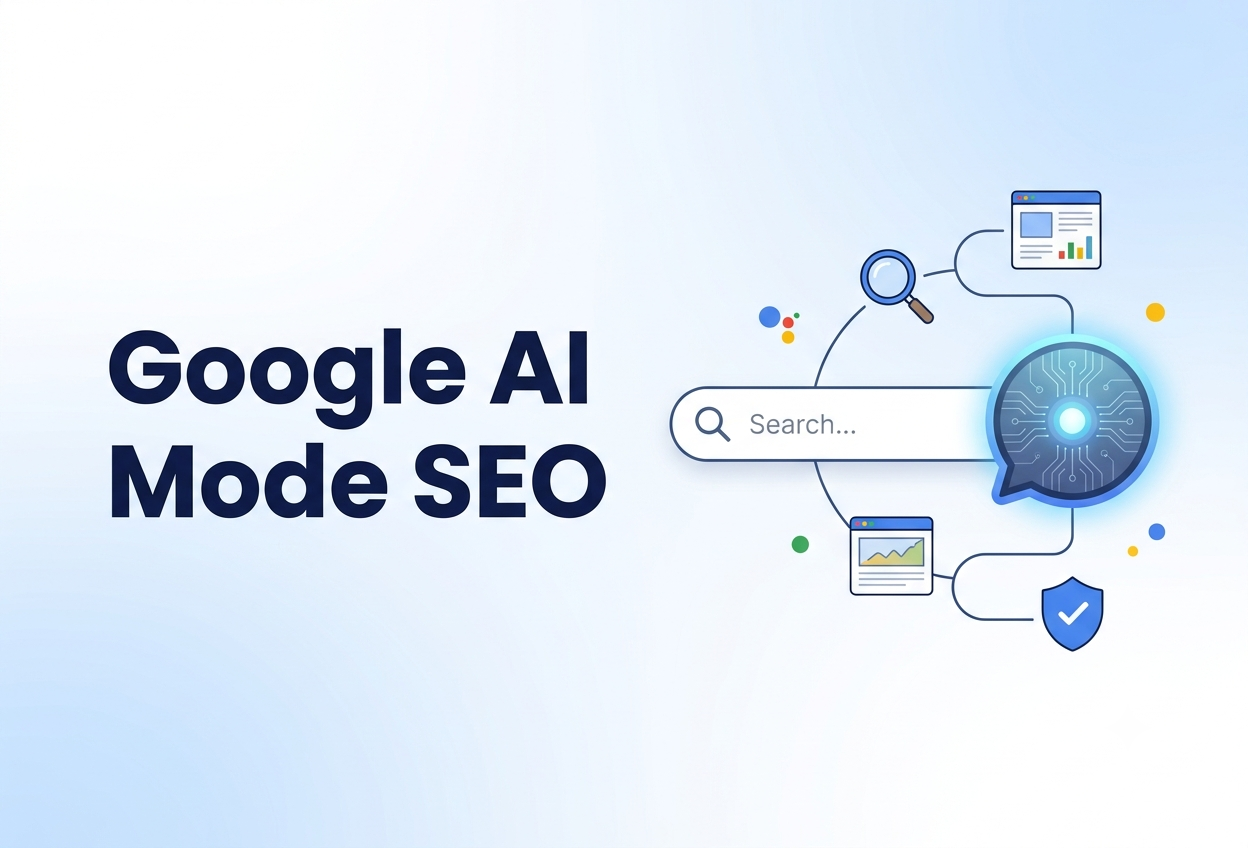
Google AI Mode SEO has quickly become one of the most important skills a modern marketing team can develop. Search no longer looks the way it did even eighteen months ago. Instead of scrolling past ten blue links, a growing share of users now type a question into Google, get a synthesized answer built by Gemini, and follow up with a clarifying question — all without ever clicking a website. If your content isn't structured to be found, understood, and cited inside that answer, you're effectively invisible to a large and rapidly growing segment of your audience.
This guide breaks down exactly what Google AI Mode SEO means in practice, how the system actually works, and the specific steps you can take today to increase your odds of being cited inside AI-generated answers. We'll also cover common mistakes, the latest trends shaping this space in 2026, and how a structured, transparent SEO partnership can help you keep pace with a search landscape that is changing every quarter.
What Is Google AI Mode?
Google AI Mode is a conversational, AI-first search experience built on Google's Gemini models, combined with Google's search index and Knowledge Graph. Instead of returning a list of ranked pages, AI Mode generates a synthesized response and lets users ask follow-up questions in the same session, much like a conversation with a knowledgeable research assistant. Google has confirmed that AI Mode uses a "fan-out" technique, issuing multiple related queries behind the scenes to gather a broader, more layered set of evidence before writing its answer.
Unlike AI Overviews, which produce a single-pass summary above traditional results, AI Mode runs an iterative, multi-turn retrieval process. Every follow-up question can trigger a fresh round of searching and synthesis, which means the system is constantly re-evaluating which sources deserve to be part of the conversation. That shift is the reason Google AI Mode SEO requires a different mindset than optimizing for a static results page.
Why Google AI Mode SEO Matters Right Now
AI Mode is no longer a small experiment tucked away in Google Labs. It has scaled to more than a billion monthly users, and query volume has continued to climb sharply since launch. At the same time, a large share of Google searches in key markets are ending without any click at all, as users get their answer directly inside the AI-generated response. For businesses that depend on organic visibility, that combination — massive AI Mode adoption plus fewer clicks overall — makes citation inside AI answers a new, non-negotiable visibility channel, not a side project.
Importantly, Google's own guidance has clarified that AI Mode optimization isn't a separate discipline bolted onto SEO. Strong foundational search engine optimization, applied correctly, is the framework AI Mode rewards. There is no secret shortcut — just a sharper, more disciplined version of the fundamentals.
Step-by-Step Guide to Optimizing for Google AI Mode SEO
Step 1: Audit Your Current AI Visibility
Before changing anything, search your core topics and services directly inside Google AI Mode. Note whether your brand appears, how it's described, and which competitors are being cited instead. This audit tells you where the gaps actually are instead of guessing.
Step 2: Fix Technical Access First
If a page isn't crawlable, indexable, or reachable through internal links, nothing else you do will matter. Check your robots.txt file, submit a clean XML sitemap, resolve redirect chains and broken links, and confirm your canonical tags are set correctly. Google indexes the mobile version of your site first, so mobile usability and Core Web Vitals — particularly Largest Contentful Paint under 2.5 seconds — directly affect whether AI Mode can retrieve your content at all.
Step 3: Strengthen Entity Clarity
AI systems reason in terms of entities — people, brands, products, and concepts — rather than isolated keywords. Make sure your company name, category, core offer, target audience, and proof points are described consistently across your website, your Google Business Profile, LinkedIn, Crunchbase, and any other public profile. Inconsistent descriptions across the web make it harder for Google's AI to confidently attach your brand to a topic.
Step 4: Turn Pages Into Answer Assets
Every important page should clearly define its topic, directly answer the primary question a searcher has, and then address the natural follow-up questions that come next. This is the core shift in Google AI Mode SEO: a page no longer wins just because it targets one keyword well. It wins because it fits cleanly into a larger, multi-part answer.
Step 5: Build Genuine Topical Depth
Cover a topic and its related subtopics in one comprehensive piece rather than spreading thin coverage across many shallow posts. Use natural language variations of your target phrase instead of repeating the exact keyword, and structure the piece with a clear hierarchy of H1, H2, and H3 headings so both readers and machines can follow the logic.
Step 6: Add Structured Data
Schema markup — Article, FAQ, Organization, and Product schema where relevant — is one of the few technical signals that AI retrieval systems read directly. Skipping structured data means leaving a visibility channel completely unused.
Step 7: Earn Mentions Across the Web
AI Mode frequently cites multiple sources for a single query, and it draws confidence from seeing a brand mentioned consistently across trusted third-party sites. Contribute genuinely helpful answers on platforms like Reddit, Quora, and industry forums, pursue guest posts on respected publishers, and keep your directory listings accurate and current.
Step 8: Track Citations, Not Just Rankings
Standard rank trackers can't yet distinguish between traditional results, AI Overviews, and AI Mode. Monitor branded search volume, direct traffic trends, and manually check how your brand appears across a sample of AI Mode queries every few weeks to understand your real visibility.
Benefits and Practical Use Cases of Google AI Mode SEO
- Earlier visibility in the buyer journey: B2B buyers increasingly use AI Mode to research vendors and compare options before ever contacting a company, so being cited there puts you in front of high-intent prospects earlier.
- Stronger brand trust signals: Consistent citation across AI answers reinforces your brand as a credible authority, which carries over into traditional rankings as well.
- Future-proofed content strategy: Content built for topical depth and clarity performs well in AI Mode, AI Overviews, and traditional search simultaneously.
- Better qualified traffic: Visitors who do click through from an AI-generated answer typically arrive with clearer intent, since the AI has already filtered out ambiguity.
- Competitive advantage in crowded niches: Many competitors are still optimizing purely for rankings; brands that adapt early to Google AI Mode SEO gain a visibility edge that's harder to close later.
Common Mistakes in Google AI Mode SEO (And How to Avoid Them)
Mistake 1: Keyword Stuffing
AI Mode does not reward repeated exact-match phrases. Overusing a keyword actually signals low-quality, over-optimized content. Fix this by focusing on information density and natural phrasing instead of repetition.
Mistake 2: Publishing Thin, Duplicative Content
A site with hundreds of shallow blog posts often loses to a site with far fewer, genuinely comprehensive pages. Consolidate overlapping content into stronger, more complete resources.
Mistake 3: Ignoring Structured Data
Skipping schema markup means AI retrieval systems have to work harder to understand your content, and they often simply move on to a competitor that made it easier.
Mistake 4: Chasing Inauthentic Brand Mentions
Google has specifically cautioned against manufacturing brand mentions across forums and social platforms purely to game AI citation signals. This tactic is increasingly targeted by core updates and can backfire badly.
Mistake 5: Writing Neutral, Perspective-Free Content
Generic "what is X" content without original insight, data, or experience rarely gets cited. Add real examples, original findings, or firsthand results to give the AI a reason to choose your page over a dozen similar ones.
Mistake 6: Ignoring Technical SEO Basics
No amount of great writing matters if the page is buried deep in your site architecture, blocked by JavaScript rendering issues, or fails Core Web Vitals. Technical health is the foundation everything else stands on.
Latest Trends and Best Practices in Google AI Mode SEO (2026)
- AI Mode has surpassed one billion monthly users, with query volume more than doubling each quarter since launch, making it a mainstream search surface rather than a niche experiment.
- Google has confirmed that answer engine optimization and generative engine optimization are not separate disciplines — strong foundational SEO applied correctly is the complete framework for AI Mode visibility.
- Google's redesigned search box now accepts multimodal input, including images, files, and open browser tabs, reflecting a broader shift toward visual and conversational search.
- "Information Agents" — background AI agents that monitor the web on a user's behalf — represent a structurally new layer of search behavior worth watching closely.
- Recent core updates appear to specifically target sites over-optimizing for AI citations through inauthentic mentions, reinforcing that authenticity and genuine authority remain the safest long-term strategy.
- Ads have begun appearing inside AI Mode for certain queries, signaling that Google is building durable monetization infrastructure around this experience rather than treating it as temporary.
How Our SEO Team Helps You Win in Google AI Mode
Adapting to Google AI Mode SEO requires ongoing technical precision, content depth, and structured data implementation — which is exactly where our agency specializes. We help businesses move beyond outdated ranking-only tactics and build a search presence designed for both traditional results and AI-generated answers.
Our Process Is Transparent, Start to Finish
We begin every engagement with a free, no-obligation SEO audit that reviews your technical health, content depth, structured data, and current visibility inside AI Mode. You'll see exactly where the gaps are before committing to anything.
Why Clients Choose Us
- Clear, jargon-free reporting so you always know what we're doing and why.
- A long-term SEO strategy built around topical authority, not short-lived tricks that risk penalties.
- Full schema and structured data implementation as a standard part of every project.
- Ongoing monitoring of your brand's presence across AI Mode, AI Overviews, and traditional rankings.
Get Started
If you're ready to find out where your brand currently stands, claim your free SEO audit today and get a clear roadmap for improving your visibility inside Google AI Mode and beyond.
Frequently Asked Questions
What is Google AI Mode SEO?
Google AI Mode SEO is the practice of optimizing content, structure, and authority signals so Google's AI Mode can find, understand, and cite your pages inside its AI-generated answers, building on traditional SEO fundamentals with added focus on topical depth and structured data.
How is Google AI Mode different from AI Overviews?
AI Overviews generate a single-pass summary above standard results for certain queries. AI Mode is a separate, full-page conversational experience with multi-turn retrieval, allowing users to ask follow-up questions in the same session.
Does keyword density still matter for AI Mode SEO?
No. AI Mode rewards information density and clarity rather than exact-phrase repetition. Content should comprehensively answer a topic using natural language.
Can small businesses compete in Google AI Mode results?
Yes. Well-structured, genuinely useful content with strong internal linking and clean structured data can outperform larger competitors that rely on thin or duplicative pages.
How long does it take to see results from AI Mode SEO?
Most businesses see measurable improvements within 8 to 16 weeks, depending on existing site authority, technical health, and competitive density in their niche.
Conclusion: Your Next Steps for Google AI Mode SEO
Google AI Mode SEO isn't a passing trend — it reflects a permanent shift in how people search and how Google delivers answers. Winning in this new environment means fixing technical access first, building genuinely comprehensive content around real topics, implementing structured data consistently, and earning authentic mentions across the web. The brands that treat these as ongoing habits, not one-time projects, will be the ones Google's AI trusts enough to cite.
Start with an honest audit of where you stand today, prioritize the fixes that unlock the most visibility, and commit to a long-term strategy rather than chasing short-term tricks. If you'd like an expert second opinion, request your free SEO audit and we'll show you exactly where the opportunities are.